
CONATHANE EN-8
Harmonization Code : 3910.00.00.90 | Silicones in Primary Forms; Others
Main features
- EN-4 System Part B
- 15-Minute System Work Life
- Room or Heat Cure
Product Description
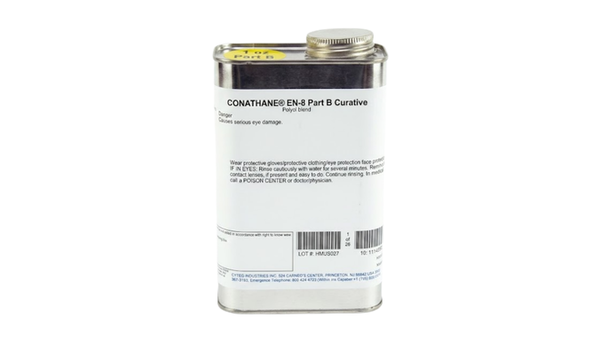
CONATHANE EN-8 Curative (Part B) is the Part B curative used with CONATHANE EN-4 Part A to form a non-MBOCA, two-component polyurethane potting and molding system. The amber liquid has a viscosity of 1,000 cP and a specific gravity of 1.00 at 25 deg C. When combined with EN-4 Part A at 100:17.5 by weight, the system provides a 15-minute working life and can cure at room temperature or with heat. Final properties apply to the complete EN-4/EN-8 system, not to the curative alone.
Key features
- Part B System Curative: completes the polyurethane system when mixed with EN-4 Part A
- 15-Minute System Work Life: provides a defined processing window after mixing with EN-4 Part A
- Room or Heat Cure: supports ambient cure or accelerated cure schedules in the complete system
Applications
Part B curative for cable, connector, module, wire-wound-device and printed-circuit potting systems using EN-4 Part A.
TDS, SDS & Technical Documents
Technical Specifications
General Properties
Physical Properties
Mechanical Properties
Electrical Properties
Additional Information
Potting, encapsulants and underfills
CONATHANE® EN-8 Curative for the EN-4 polyurethane system
CONATHANE® EN-8 is the Part B curative used with CONATHANE® EN-4 Part A Urethane Prepolymer to form a two-component, non-MbOCA-based polyurethane system for electrical and electronic potting, molding, encapsulation, and coating applications. The EN-4 plus EN-8 system provides approximately 15 minutes of working life and can cure at room temperature or through accelerated elevated-temperature schedules. Mixed and cured properties apply to the complete EN-4 plus EN-8 system and do not describe EN-8 Part B alone.
Technical properties
EN-8 Part B as-supplied properties
These values describe EN-8 Part B before mixing with EN-4 Part A. Mixed-material and cured properties are shown separately below.
| Property | Value | Unit | Method / condition |
|---|---|---|---|
| Appearance | Amber | Not applicable | As supplied |
| Viscosity | 1,000 | cP | 25°C |
| Specific gravity | 1.00 | Unitless | 25°C |
| Unopened shelf stability | 15 | months | At 25°C, from date of manufacture |
EN-4 plus EN-8 system
Component and mix information
EN-8 Part B is combined with EN-4 Part A to form the complete polyurethane system. Keep the component and mixed-system values distinct when evaluating or processing the material.
| Property | EN-4 Part A | EN-8 Part B | Condition / unit |
|---|---|---|---|
| Appearance | Amber liquid | Amber | As supplied |
| Viscosity | 9,000 | 1,000 | cP at 25°C |
| Specific gravity | 0.97 | 1.00 | 25°C |
| NCO content | 8.9 to 9.1% | Not applicable | As supplied |
| Mix ratio | 100 parts EN-4 Part A : 17.5 parts EN-8 Part B | By weight | |
Processing window
Mixed viscosity development
The EN-4 plus EN-8 system has an approximate working life of 15 minutes. The mixed viscosity increases rapidly after mixing, progressing from 5,550 cP initially to 17,000 cP after 10 minutes and reaching gel by the 20-minute measurement point at 25°C.
| Property | Elapsed time | Typical value | Condition |
|---|---|---|---|
| Mixed viscosity | Initial | 5,550 cP | 25°C |
| Mixed viscosity | 10 min | 17,000 cP | 25°C |
| Material state | 20 min | Gel | 25°C |
| Peak exotherm | 2 lb mass | 55°C | Mixed at 25°C |
Processing distinction: The approximately 15-minute working life and the 20-minute gel measurement describe different processing points and should not be used interchangeably.
Processing
Mix, degas, cast, and cure
Prepare and combine
Mix EN-4 Part A and EN-8 Part B thoroughly at 25°C to 40°C using metal, plastic, or glass stirrers and containers. Use 100 parts EN-4 Part A to 17.5 parts EN-8 Part B by weight.
Degas
Degas the mixed material at 1 to 5 mm Hg. Use a container with sufficient capacity for material expansion during the vacuum-degassing cycle.
Cast
Pour the degassed mixed material into molds at temperatures from 25°C to 100°C. Avoid materials or containers that can introduce moisture into the polyurethane system.
| Stage | Temperature | Recommended time |
|---|---|---|
| Cure | 25°C | 5 to 7 days |
| Cure | 60°C | 4 hours |
| Cure | 80°C | 2 hours |
| Cure | 100°C | 1 hour |
| Demold | 60°C | 2 hours |
| Demold | 80°C | 1 hour |
Cured system
Typical cured properties
The bulletin reports very similar cured properties for EN-7 and EN-8 when processed as recommended. EN-8 test specimens were cured for 7 days at 25°C.
| Property | Typical value | Unit | Method / condition |
|---|---|---|---|
| Color | Amber or black | Not applicable | Visual |
| Specific gravity | 1.01 | Unitless | ASTM D792, 25°C |
| Hardness | 90 | Shore A | ASTM D2240 |
| Tensile strength | >2,000 | psi | ASTM D412 |
| 100% modulus | 800 | psi | ASTM D412 |
| 300% modulus | 1,200 | psi | ASTM D412 |
| Ultimate elongation | >400 | % | ASTM D412 |
| Tear strength, Die C | >200 | pli | ASTM D624 |
| Linear shrinkage | 1.15 | % | Cytec / MIL-M-24041 |
| Volumetric shrinkage | 3.7 | % | Cytec / MIL-M-24041 |
| Water absorption | 0.20 | % | ASTM D570, 24 h at 25°C |
| Water absorption | 0.43 | % | ASTM D570, 30 d at 25°C |
| Heat-aging weight loss | 0.41 | % | MIL-M-24041, 7 d at 135°C |
| Shore A hardness change after heat aging | +5 | Shore A points | 7 d at 135°C |
| Fungus resistance | Non-nutrient | Result | MIL-E-5272C / MIL-STD-810B |
| Thermal shock | Pass | 10 cycles | Olyphant washer, 130°C to -70°C, MIL-L-16923E |
| Compression set | 31 | % | ASTM D395, Method B |
Data scope: These are typical values and are not intended to serve as specifications. The source groups EN-7 and EN-8 cured properties together and states that the two systems have very similar properties when processed as recommended.
Electrical performance
Typical cured-system electrical properties
Electrical data are reported for the cured EN-7 and EN-8 polyurethane systems across temperatures up to 130°C.
| Property | 25°C | 105°C | 130°C | Method |
|---|---|---|---|---|
| Dielectric constant, 100 Hz | 3.0 | 4.0 | 3.8 | ASTM D150 |
| Dielectric constant, 1 kHz | 2.9 | 3.8 | 3.8 | ASTM D150 |
| Dielectric constant, 1 MHz | 2.8 | 3.1 | 3.3 | ASTM D150 |
| Dissipation factor, 100 Hz | 0.032 | 0.030 | 0.032 | ASTM D150 |
| Dissipation factor, 1 kHz | 0.033 | 0.022 | 0.033 | ASTM D150 |
| Volume resistivity | >4.3 x 10¹⁵ | 4.1 x 10¹² | 7.4 x 10¹¹ | ASTM D257, ohm-cm |
| Surface resistivity | >1.0 x 10¹⁵ | 4.2 x 10¹² | 1.6 x 10¹² | ASTM D257, ohms |
| Insulation resistance | >2.5 x 10¹³ | 2.3 x 10¹¹ | 2.3 x 10¹⁰ | MIL-M-24041, ohms |
| Dielectric strength, 1/16 in | 785 V/mil | Not reported | Not reported | MIL-M-24041 |
| Arc resistance | >120 sec | Not reported | Not reported | ASTM D495 |
Hydrolytic stability
Property retention during 97°C / 95% RH exposure
The EN-7 and EN-8 bulletin reports elastomer properties after continuous exposure at 97°C and 95% relative humidity. Specimens were tested within 24 hours after removal from the chamber.
| Property | Original | 28 days | 56 days | 84 days | 112 days | Unit |
|---|---|---|---|---|---|---|
| Hardness | 94 | 94 | 94 | 88 | 87 | Shore A |
| Tensile strength | 2,250 | 1,600 | 1,400 | 900 | 775 | psi |
| 300% modulus | 1,750 | 1,175 | 1,100 | 800 | 700 | psi |
| Ultimate elongation | 400 | 420 | 430 | 390 | 370 | % |
| Tear strength, Die C | 322 | 281 | 285 | 197 | 187 | pli |
| Dielectric constant, 1 kHz at 25°C | 2.9 | Not reported | Not reported | Not reported | 3.0 | Unitless |
| Dissipation factor, 1 kHz at 25°C | 0.033 | Not reported | Not reported | Not reported | 0.030 | Unitless |
| Volume resistivity at 25°C | >4.2 x 10¹⁵ | Not reported | Not reported | Not reported | 2.8 x 10¹⁵ | ohm-cm |
| Dielectric strength, 1/16 in | 785 | Not reported | Not reported | Not reported | 566 | V/mil |
Data scope: Hydrolytic-stability data are presented in the source for elastomers prepared from the EN-7 and EN-8 systems rather than as separately identified EN-8-only measurements.
Adhesion data
Typical peel strength on primed substrates
The cured EN-7 and EN-8 systems show greater than 20 piw peel strength on the listed substrate and primer combinations.
| Substrate | Primer | Typical peel strength | Unit |
|---|---|---|---|
| Aluminum | AD-1146-C | >20 | piw |
| Stainless steel | AD-1146-C | >20 | piw |
| Neoprene | DPPR-7156 | >20 | piw |
| PVC | AD-1161 | >20 | piw |
Applications
Electrical and electronic protection applications
The EN-4 plus EN-8 system is recommended for molding, potting, encapsulation, and selected bonding and coating applications.
Cables and connectors
Molding and potting of electrical cables and connectors.
Modules and wound devices
Potting and encapsulation of modules, wire-wound devices, and strain-sensitive devices.
Printed circuitry
100%-solids coatings for printed circuitry.
Staking and filleting
The adhesion and flexibility of the cured systems also support evaluation for staking and filleting adhesive applications.
Storage and handling
Maintain dry storage conditions
The stated shelf life of EN-4 Part A, EN-7 Part B, and EN-8 Part B is 15 months from date of manufacture when stored in the original unopened containers at 70°F to 85°F.
If a container is opened and only partially used, flush the container with dry nitrogen before resealing to limit moisture exposure.
EN-4 Part A may crystallize during storage or shipment. If crystallization occurs, heat EN-4 Part A to 60°C, mix thoroughly, and cool to room temperature before processing.
Discuss the EN-4 plus EN-8 system
Krayden can help evaluate the EN-4 plus EN-8 system around the approximately 15-minute working life, rapidly increasing mixed viscosity, ambient or accelerated cure schedule, electrical requirements, environmental exposure, adhesion needs, assembly geometry, and dispensing process.
Contact Us


